Challenge
As development progressed, the requirements evolved significantly. The most complex change involved sealing a manifold that had never been designed to be sealed, forcing a re-think of the engineering and tooling strategy without disrupting the industrial design or delaying delivery.
Other constraints included:
- Tight, non-negotiable geometry around ultra-sensitive sensors
- Evolving electronics layouts
- Strict regulatory and hygiene requirements
- A shift from a removable to permanent mouthpiece, requiring a new tooling approach
- A need to ensure the device could be manufactured reliably and at scale
3fD’s remit was to engineer the internals, define the assembly strategy, protect the sensors, and ensure the final device was pilot-build ready—all while maintaining the existing industrial design language.
Our Approach
We ran an accelerated and tightly controlled engineering programme, designed specifically for projects where requirements evolve but timelines do not.
Key areas of focus
- Complex Engineering
Developed tooling and manufacturing strategies to deliver new seal requirements without forcing a redesign. - Manifold Sealing & Containment
Engineered airtight internal seals to ensure zero contamination risk. - Ultrasonic Welding
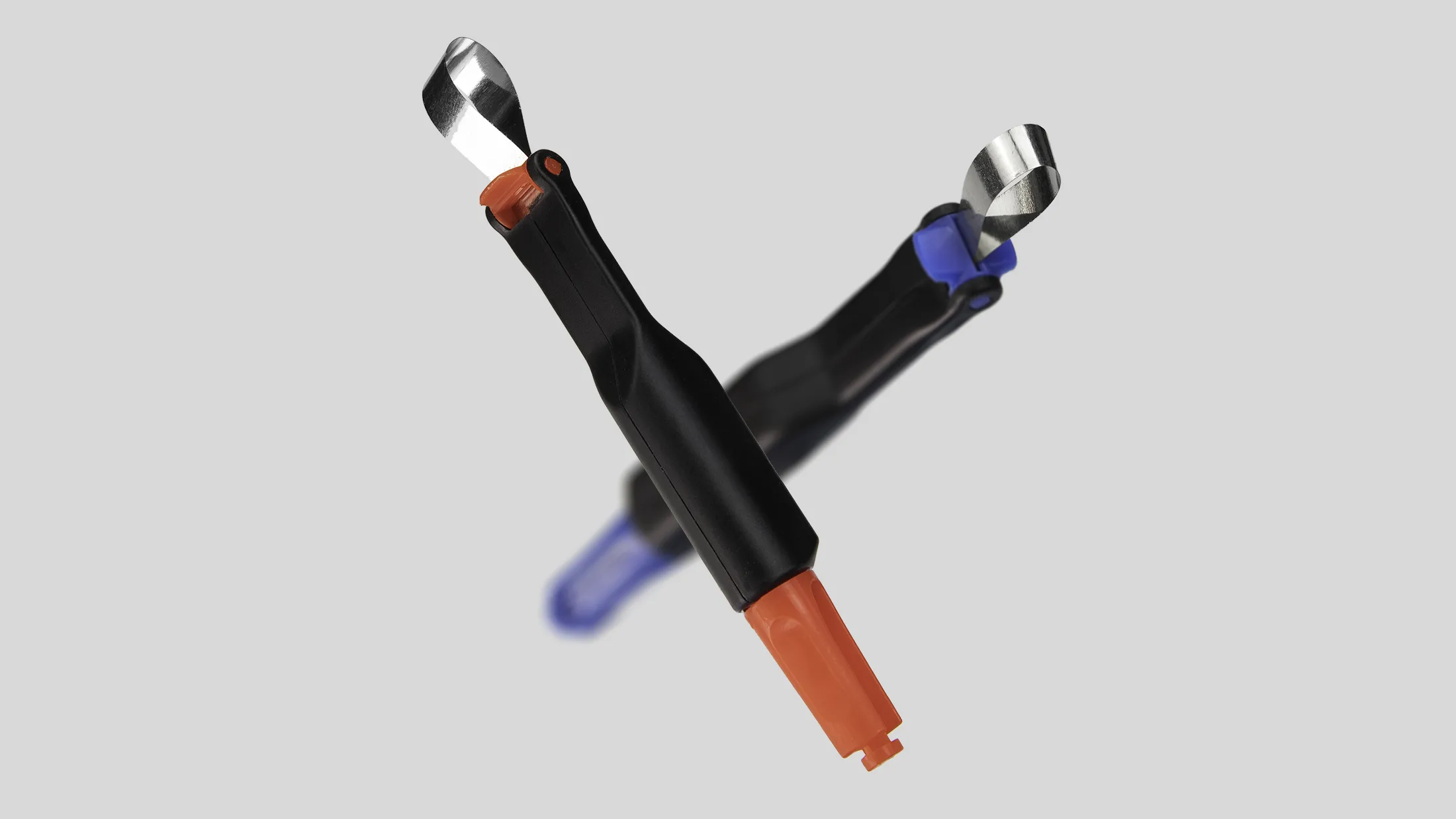
Refined welding parameters and features to produce clean, repeatable weld seams along the breath-flow path. - Hygienic, Functional Geometry
Considering dirt traps, optimised the mouthpiece geometry, and reduced fasteners and laser-etch for a clinical finish. - Assembly Optimisation
Protected the sensor array from off-gassing materials and environmental contamination.
Throughout, we preserved the industrial design while completely re-engineering the internals for manufacturability, sensor safety, and reliability.


Engineering & Manufacturing
The engineering challenges demanded unconventional solutions. We created advanced tooling strategies that allowed mid-project requirement changes to be absorbed without restarting the design.
All components were manufactured in an FDA-registered facility operating a Quality Management System compliant with 21 CFR Part 820 and certified to ISO 13485.
Every assembly step was designed to:
- Protect the ultra-sensitive sensors
- Maintain clinical-grade cleanliness
- Avoid contamination from materials or processes
- Support scalable production
This integration of engineering, tooling, and controlled manufacturing ensured the OMED pilot build was delivered on time, fully functional, and compliant.
Outcome
3fD delivered production-ready OMED device components within the required deadline, enabling Owlstone Medical to complete their pilot build and progress their investment activities.
The final device:
- Safeguarded the proprietary sensor technology
- Met stringent hygiene and functional requirements
- Was optimised for reliable, scalable manufacturing
- Performed consistently in clinical environments
What We Learned
Time-critical programmes demand tight coordination between design, engineering, and manufacturing. By staying flexible and engineering-led, we delivered a fully sealed, clinically robust medical device under evolving constraints—while protecting the customer’s IP and commercial goals.